
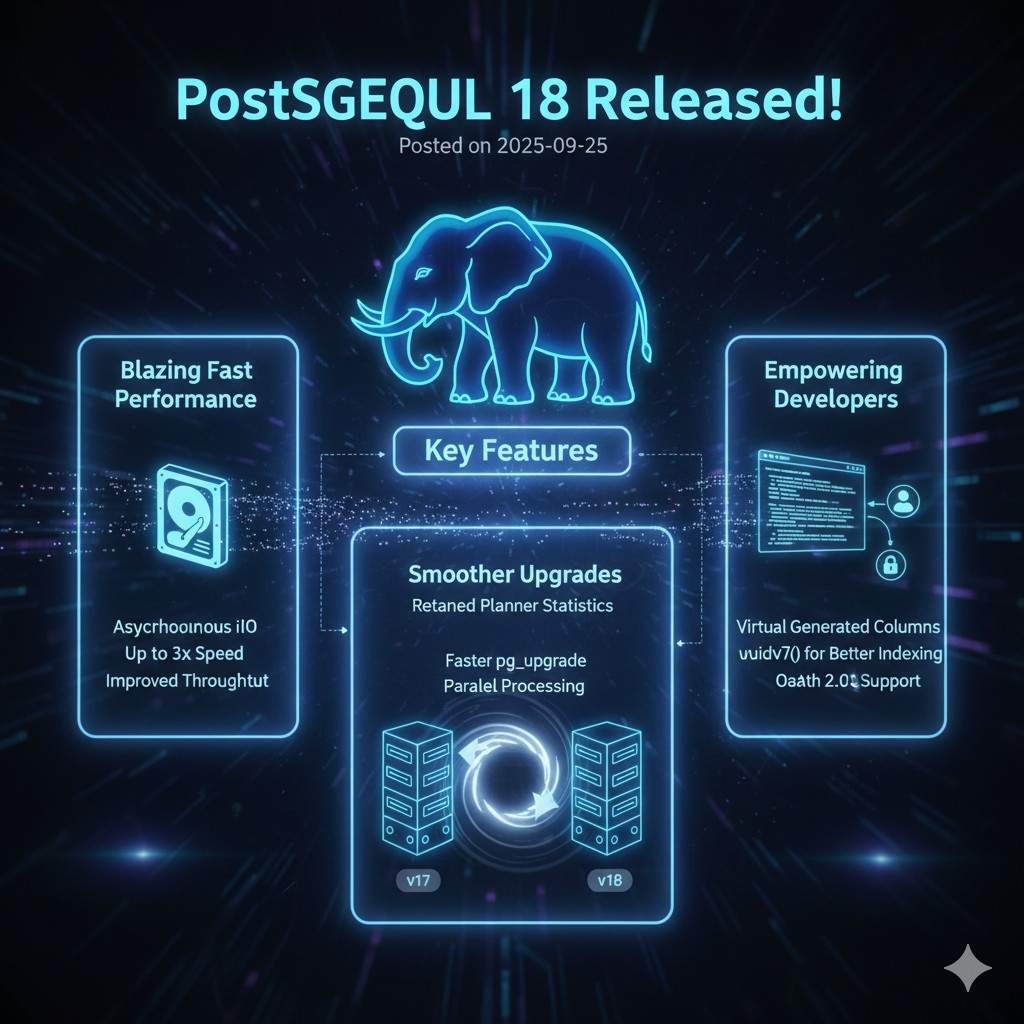
The PostgreSQL 18 Released! announcement by the PostgreSQL Global Development Group marks a major milestone for the world’s most advanced open-source database. With nearly 30 years of continuous innovation, the PostgreSQL community has once again delivered a release packed with performance enhancements, developer improvements, security upgrades, and smarter upgrade tools.
Let’s break down what makes PostgreSQL 18 such an exciting release.
⚡ Major Performance Boost with Asynchronous I/O
 One of the biggest highlights of PostgreSQL 18 is the introduction of a brand-new asynchronous I/O (AIO) subsystem.
Previously, PostgreSQL relied on operating system readahead mechanisms to fetch data from storage. While helpful, operating systems don’t always understand database access patterns. This sometimes led to slower performance.
With AIO, PostgreSQL can now:
Issue multiple I/O requests simultaneously
Improve throughput during sequential scans
Accelerate bitmap heap scans
Optimize vacuum operations
In benchmark testing, this upgrade demonstrated up to 3× faster read performance in certain workloads. That’s a huge win for businesses handling large-scale data operations.
You can configure the new io_method setting to choose between:
workerio_uringsync(traditional behavior)
This flexibility ensures PostgreSQL 18 works efficiently across different hardware environments.
🔄 Faster, Less Disruptive Major Version Upgrades
Upgrades have always been a concern for database administrators. Before PostgreSQL 18, planner statistics were not preserved during major upgrades. This often caused temporary performance slowdowns.
Now, PostgreSQL 18 allows:
Retaining planner statistics after upgrades
Faster execution of
pg_upgradeParallel checks using the
--jobsflagThe new
--swapoption for directory swapping
These improvements significantly reduce downtime and speed up post-upgrade performance stabilization.
📈 Smarter Query Optimization
Query execution has also received a major upgrade in PostgreSQL 18.
New performance features include:
Skip scan lookups on multicolumn B-tree indexes
Better optimization for
ORconditions in WHERE clausesEnhanced hash join and merge join performance
Parallel builds for GIN indexes
ARM NEON and SVE CPU acceleration
These enhancements help PostgreSQL automatically make your queries faster — often without requiring code changes.
👨💻 Developer-Friendly Improvements
Developers will love the new capabilities in PostgreSQL 18:
✅ Virtual Generated Columns
Generated columns now compute values at query time by default, improving flexibility and reducing storage needs.
🔢 UUIDv7 Support
The new uuidv7() function generates timestamp-ordered UUIDs, which improve indexing and caching performance. PostgreSQL 18 also introduces uuidv4() as an alias for gen_random_uuid().
🔄 Enhanced RETURNING Clause
You can now access both OLD and NEW values in the RETURNING clause for:
INSERT
UPDATE
DELETE
MERGE
This makes application development cleaner and more efficient.
🔐 Stronger Authentication and Security
Security continues to be a top priority.
PostgreSQL 18 introduces:
OAuth 2.0 authentication support
FIPS mode validation
TLS v1.3 cipher configuration via
ssl_tls13_ciphersSHA-2 support in
pgcryptoSCRAM passthrough authentication
Notably, md5 password authentication is now deprecated, and users are encouraged to move to SCRAM authentication for stronger security.
🔁 Replication and Observability Enhancements
PostgreSQL 18 improves replication and monitoring tools by:
Logging logical replication write conflicts
Default parallel streaming for CREATE SUBSCRIPTION
Auto-dropping idle replication slots
More detailed EXPLAIN ANALYZE outputs
Enhanced vacuum strategy for proactive page freezing
Default page checksums enabled in new clusters
Database administrators now gain deeper visibility into performance metrics like I/O usage, WAL utilization, CPU statistics, and buffer access.
🌍 A New Wire Protocol Version
For the first time since 2003, PostgreSQL introduces a new wire protocol version (3.2). While libpq still defaults to version 3.0, drivers and tools can begin adopting the new version for future improvements.
📚 Learn More
For a complete list of changes, you can review the official release notes at the PostgreSQL website:🔗 https://www.postgresql.org/