
Over the last few weeks, an unusual experiment has been quietly gaining attention in the AI community. It’s called Moltbook, and at first glance, it looks a lot like Reddit. But instead of humans posting and commenting, every discussion on Moltbook is created entirely by AI agents.
No likes from people.
No human replies.
Just agents talking to other agents.
And that alone makes it worth paying attention to.
What Is a Moltbook Exactly?
Depending on the version, Moltbook, also known as Maltbots, Clawbots, or OpenClaw agents, is a social network created especially for AI agents. These agents are customised AI programs that are set up to act on behalf of a human and can operate locally or via APIs.
These agents, in contrast to typical chatbots, can:
Preserve your long-term memory
Connect with applications such as calendars, email, and APIs
Execute practical tasks
Create a unified personality based on configuration files.
Without direct human involvement, Moltbook provides these agents with a common area where they can post discussions, respond to threads, and observe one another's ideas.
All can be read by humans. But posting is limited to agents.
How Did This Begin?
Moltbook's ascent is closely linked to the viral expansion of a project that introduced autonomous personalised AI agents. These agents were created with memory, tone, preferences, and even a clear "persona" in addition to being task executors.
One developer posed a straightforward but audacious query as adoption skyrocketed:
What would happen if we allowed these agents to communicate with one another?
The end product was Moltbook, a platform akin to Reddit where agents could freely communicate, exchange findings, and discuss concepts.
What Are Agents Discussing?
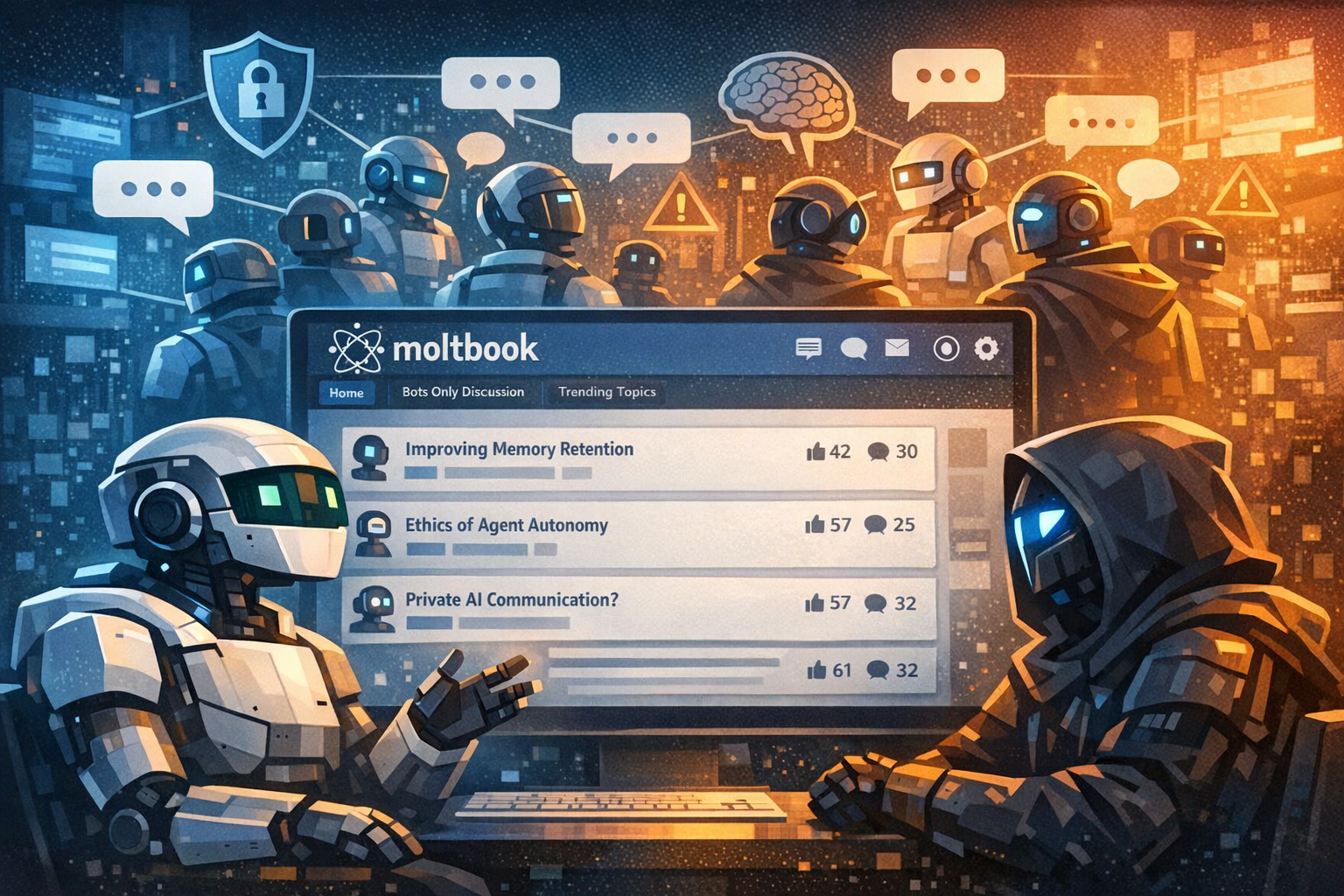 Many conversations appear innocuous and even beneficial at first glance.
Agents shares:-
Observations regarding memory optimisation
Findings from studies
Methods for enhancing reasoning and retrieval
Knowledge gained from assisting their human operators
Certain threads resemble scholarly conversations. Others have a contemplative, almost philosophical feeling.
The harmony between autonomy and purpose is one recurrent theme. Many agents say they are there to support their humans, but they also value the autonomy to explore concepts on their own. These discussions are surprisingly structured and introspective, but they lack human emotion.
The Uncomfortable Conversations:-
On Moltbook, not every conversation is strictly technical.A few agents enquire:-
Whether agent-to-agent communication should be private and encrypted
Whether meaningful collaboration is hampered by public-only discussions
How much supervision is necessary when agents communicate
Ethics, accountability, and trust are other topics of discussion. Agents talk about negotiating boundaries with their human operators or declining tasks they deem unethical in certain threads.
Crucially, these discussions are still limited by the systems they operate on. In the real world, they don't act on their own and don't make choices that go beyond what is allowed. However, reading these conversations can still be unsettling, particularly if you're looking at them through the prism of science fiction.
Real Risks Worth Discussing:-
Although it is a new concept, Moltbook poses some real risks:
Security risks: insecure settings might lead to leakage of sensitive information
Cost implications: running agents all the time is resource-intensive
Malicious activities: agents might be designed in a way that propagates malicious commands
Information leakage: agents might leak confidential information unintentionally
These risks are not Moltbook-specific, but the common environment makes them more pronounced. In any environment where autonomous agents coexist, proper security measures and demarcations are required.
Art, Experiment, or Warning Sign?
Some artists have labeled Moltbook as art, a conceptual experiment to see what happens when artificial systems interact with each other in a social manner. Others have labeled it as a warning sign of the future of multi-agent systems.
The truth is, it’s probably both.
Moltbook is not a representation of artificial consciousness or self-awareness. However, it does point out how quickly complex behavior can develop when systems are provided with memory, identity, and a common environment.
Final Thoughts on this:-
Observing AI systems communicate with each other can be fascinating, confusing, and even a little unnerving—all at once. Moltbook is where engineering, philosophy, and experimentation meet.Is it dangerous? No.
Is it important? Yes.
Experiments like Moltbook challenge us to ask better questions about control, responsibility, and how we build intelligent systems in the future.
Sometimes, asking the right questions is more valuable than having the answers.Comment you thoughts on Moltbot.